A panel saw is one of the most productive machines in a woodworking workshop. It cuts plywood, MDF, laminated boards and particle board quickly and accurately, sheet after sheet. It is also one of the machines where a lapse in attention can cause a serious injury in less than a second.
Most panel saw accidents are not caused by “bad luck.” They come from predictable situations: a removed guard, a hand too close to the blade, a board that pinches and kicks back, or a worker rushing at the end of a long shift. The good news is that nearly all of these situations can be prevented with the right machine setup, safety devices and daily habits.
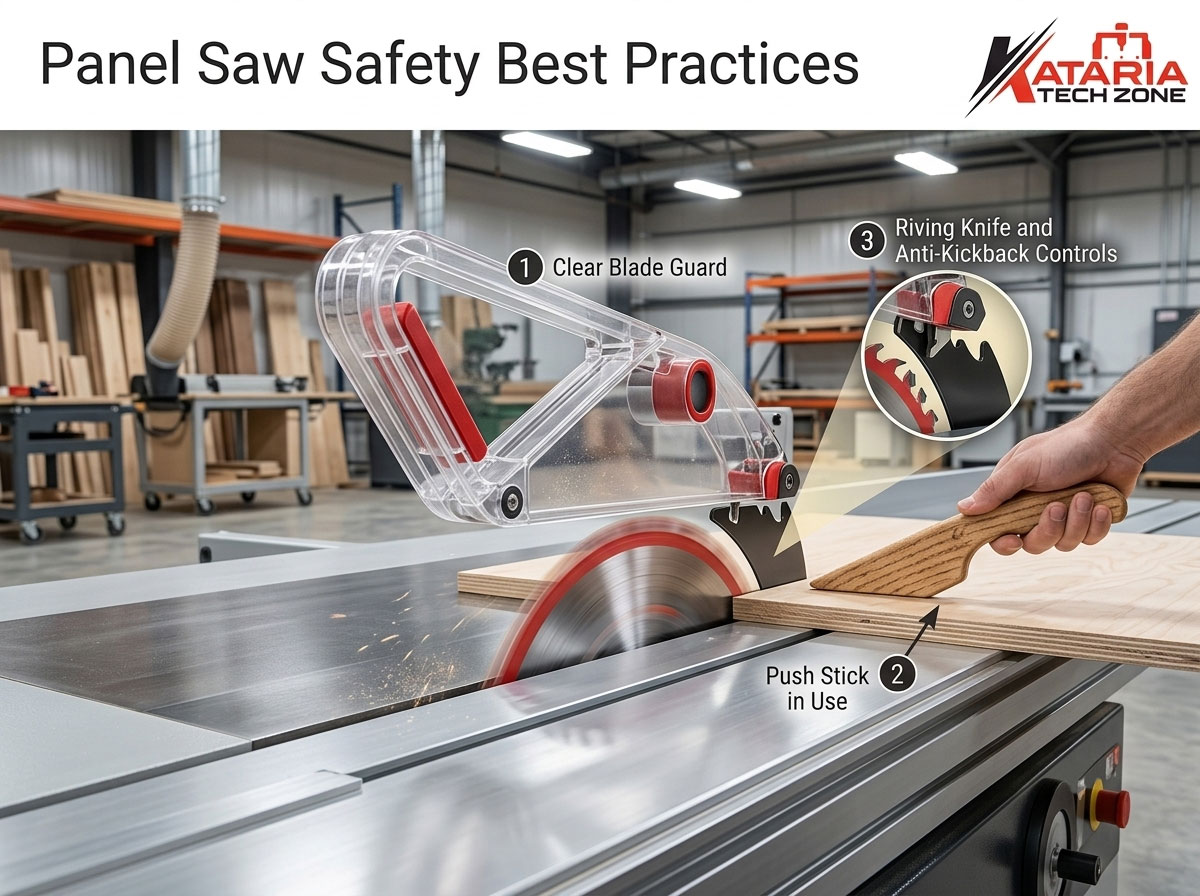
This guide explains the three pillars of panel saw safety, blade guards, push sticks and anti-kickback controls, then covers the supporting practices that keep your operators protected and your production steady.
Why Panel Saw Safety Deserves Real Attention
A saw blade turning at high speed stores a great deal of energy. It does not distinguish between a sheet of plywood and a hand. In a busy workshop, operators repeat the same cut hundreds of times, and repetition creates familiarity, which can quietly turn into carelessness.
Beyond the human cost, there are business reasons to take safety seriously:
- Injuries stop production. A single accident can sideline a skilled operator and disrupt the entire cutting line.
- Kickback damages materials and machines. A board thrown back at speed can crack, ruin an expensive sheet and strain the saw.
- Safe machines cut better. Guards, clamps and well-set fences keep the material stable, which improves cut quality as well as safety.
- Confident operators work faster. Workers who trust their machine are not hesitating or improvising workarounds.
Safety is not a cost added on top of productivity. In a well-run workshop, the two support each other.
Pillar 1: Blade Guards
What a Blade Guard Does
A blade guard is a physical barrier that covers the saw blade when it is not actively cutting, and in many designs, while it is cutting. It reduces the chance of accidental contact with the blade and helps contain chips and fragments.
Depending on the machine, guards may include:
- A top blade guard or hood over the blade.
- A riving knife or splitter positioned behind the blade (covered under anti-kickback below).
- Dust hood guards that enclose the cutting area and connect to dust extraction.
- Side and rear enclosures that restrict access to the moving carriage and blade assembly.
Never Remove or Bypass the Guard
The most dangerous habit in any workshop is removing the guard to “make the cut easier” or “see the line better.” A guard that is removed for one job often stays off for the next hundred. If a guard genuinely interferes with a particular cut, the correct answer is to adjust it, use a different setup or choose a different machine, not to run without it.
Blade Guard Checks Before Every Shift
Build a simple routine into the start of each day:
- Confirm the guard is in place and not cracked, bent or loose.
- Check that it moves freely and returns to its covering position without sticking.
- Inspect the dust hood for blockages. A clogged hood reduces visibility and can make operators lean closer.
- Look for missing fasteners or signs that someone has modified the guard.
- Report damage immediately and take the machine out of service until it is fixed.
Dust buildup is a hidden guard problem. Heavy sawdust around the blade area can jam moving guard parts or hide loose fittings, so regular cleaning is part of guard maintenance. Our CNC router maintenance checklist explains how a daily, weekly and monthly routine keeps woodworking machinery in safe working condition, and the same discipline applies to your panel saw.
Pillar 2: Push Sticks and Hand Positioning
Why Hands Need a Safe Distance
When a hand follows a workpiece toward a blade, the margin for error is tiny. Push sticks, push blocks and clamps exist for one purpose: to let the operator control the material while keeping hands well away from the cutting line.
Choosing the Right Push Tool
- Push sticks are used for narrow cuts and the final portion of a pass, where a hand would otherwise have to travel close to the blade.
- Push blocks give broader contact and better downward pressure on wider boards, helping the material stay flat on the table.
- Feather boards and hold-downs keep stock pressed against the fence or table without hands near the blade.
- Built-in clamps and pressure beams on machines such as sliding panel saws hold the sheet firmly during the cut, reducing the need for hand pressure altogether.
Keep push tools easy to reach. If they are stored across the room, operators will skip them. Many workshops hang a push stick on the machine itself so there is no excuse.
Safe Hand Positioning Rules
- Keep hands out of the blade path and out of the line of a possible kickback at all times.
- Never reach over or behind the blade while it is spinning.
- Never use your hand to clear offcuts near the blade until it has completely stopped.
- Do not hold small pieces by hand. Use a jig, clamp or push tool instead.
- Stand to the side of the cutting line, not directly behind the workpiece, so a kickback does not travel straight at your body.
Make Your Own Push Sticks Fit the Job
A push stick wears out. Edges chip, notches round off and grip fades. Replace damaged ones immediately, and keep several sizes for different material thicknesses. A cheap push stick that fails mid-cut is far worse than no push stick, because the operator trusts it.
Pillar 3: Anti-Kickback Controls
What Kickback Is and Why It Happens
Kickback occurs when the saw blade catches the workpiece and throws it back toward the operator, often at high speed. The most common causes are:
- Pinching. The cut kerf closes behind the blade, gripping the blade and driving the board backwards.
- Misaligned fence. If the fence is not parallel to the blade, the board can bind against the blade as it passes through.
- Warped or internally stressed material. Boards that twist or spring open as they are cut can trap the blade.
- Dull or incorrect blades. A blade that must be forced through the material increases the chance of grabbing and binding.
- Freehand cutting. Cutting without a fence or proper support lets the workpiece rotate into the blade.
- Releasing the workpiece mid-cut or letting offcuts drift into the blade path.
Anti-Kickback Devices That Matter
Riving knife or splitter. This thin plate sits directly behind the blade, rising and falling with it. It keeps the cut kerf open, so the material cannot pinch the blade. It is one of the most effective kickback defences available and should never be removed during normal through-cuts.
Anti-kickback pawls. These toothed devices let material move forward but dig in if the board tries to move backward, helping to stop a kickback event.
Clamping and hold-down systems. A properly clamped sheet cannot rotate or lift into the blade. On a sliding panel saw, the pressure beam and carriage clamp provide this control.
Fence and stop systems. A parallel, locked fence keeps the cut straight and the workpiece predictable.
Controlling Kickback Through Setup
Machine devices only work when the machine itself is set up correctly. Check these before production starts:
- Fence alignment: the fence must run parallel to the blade. A misaligned fence is both a quality problem and a safety problem.
- Blade height: set the blade to extend only slightly above the material. A higher blade exposes more teeth and increases risk.
- Riving knife alignment: it must sit in line with the blade and at the correct distance from the teeth.
- Table and carriage condition: a worn or sticky carriage causes uneven feeding and sudden snags.
Blade Choice and Condition Matter More Than You Think
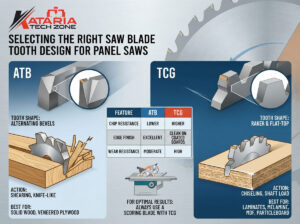
A dull blade forces the operator to push harder, which increases heat, burning and the chance of binding. The wrong tooth design for the material creates the same problem. If you are cutting laminated panels, melamine or plywood, matching the blade to the job reduces both chip-out and forced feeding. Read our guide on selecting the right saw blade tooth design (ATB, TCG) for panel saws to match blades to materials, and our troubleshooting article on scoring blade setup on sliding panel saws for clean cuts on laminated boards without excessive force.
Safety Features to Look For When Buying a Panel Saw
Safety starts with the machine you choose. When comparing models, ask about:
- Integrated blade guarding and dust hoods that cannot be casually removed.
- A riving knife or splitter fitted as standard.
- Pressure beams and clamps that hold the sheet firmly during the cut.
- Emergency stop buttons that are easy to reach from the operator position.
- Blade brakes that stop the blade quickly after cutting.
- Interlocked access doors that cut power when opened for blade changes or maintenance.
- Stable carriage and rail design that reduce vibration and wandering cuts.
- Dust extraction connection for cleaner air and clearer visibility.
A well-built sliding panel saw also reduces the need for operators to manually handle heavy sheets near the blade. If you are weighing machine types, see our guide on choosing between a vertical and horizontal panel saw and explore the full range in our Panel Saw category.
Safe Panel Saw Operating Procedure: A Step-by-Step Routine
Before Starting
- Inspect the machine. Check guards, riving knife, clamps, emergency stop and dust extraction.
- Clear the area. Remove offcuts, tools and clutter from the table and floor around the saw.
- Check the blade. Make sure it is sharp, clean, undamaged and the right type for the material.
- Set blade height and confirm fence alignment.
- Wear proper protection: safety glasses, hearing protection and a dust mask or respirator suited to the material.
During Cutting
- Support the sheet fully. Large panels must be supported before, during and after the cut.
- Clamp the material as designed by the machine.
- Start the blade and let it reach full speed before beginning the cut.
- Feed at a steady rate. Do not force the cut or stop mid-pass.
- Keep your attention on the cut. Do not talk, answer phones or look away.
- Use push tools for narrow pieces or final passes.
After the Cut
- Let the blade stop completely before removing offcuts.
- Never reach across a moving blade.
- Clear sawdust and keep the machine tidy.
- Switch off and isolate power before any adjustment or blade change.
Workshop Habits That Protect Your Team
Safety is partly about machines and partly about culture. A few practices make a lasting difference:
Train every operator properly. New staff should never learn on live production runs. Give them supervised practice, explain the reason behind each rule and test their understanding before they work alone.
Never allow guards to be removed for convenience. Make this a firm workshop policy, and make sure supervisors enforce it consistently.
Keep the floor clear. Sawdust, offcuts and cables create trip hazards, and a stumble near a running saw is dangerous.
Manage fatigue. Tired operators make mistakes. Rotate tasks on long cutting days and allow regular breaks.
Light the work area well. Poor lighting hides the cutting line and encourages operators to lean closer.
Control dust. Wood dust affects breathing and can create a fire hazard. A well-planned extraction setup supports both health and visibility. The same principles are covered in our guide to planning the workshop layout for a modern modular furniture factory, where safe material flow around machines is a central consideration.
Check your electrical supply. Unstable or undersized power can cause stalling, sudden slowdowns and inconsistent blade speed. If you run industrial machinery in a smaller facility, read our article on single-phase power solutions for running industrial machinery in small workshops.
Common Panel Saw Safety Mistakes to Avoid
- Removing the guard “just for this cut.” It rarely stays temporary.
- Using the saw with a dull blade. It increases force, heat and kickback risk.
- Skipping the riving knife on through-cuts.
- Cutting unsupported sheets that tip, sag or twist.
- Using hands instead of push tools for narrow pieces.
- Standing directly in line with the blade.
- Wearing loose clothing, jewellery or dangling items near moving parts.
- Making adjustments while the blade is still turning.
- Rushing at the end of a shift when attention is lowest.
- Ignoring unusual noise or vibration instead of stopping to investigate.
Panel Saw Safety Checklist (Print and Display)
Daily
- Guards fitted, undamaged and moving freely
- Riving knife aligned
- Emergency stop tested
- Blade sharp and suited to the material
- Dust extraction running
- Work area clear
Weekly
- Fence and carriage alignment checked
- Clamps and pressure beam inspected
- Push sticks and push blocks replaced if worn
- Electrical cables and plugs examined
Monthly
- Full machine inspection by a qualified technician
- Lubrication and wear checks on moving parts
- Refresher reminder for all operators
Final Thoughts
Panel saw safety comes down to three habits: keep the blade guarded, keep your hands away from the blade, and control the material so it cannot bind or kick back. Blade guards, push sticks and anti-kickback devices are simple, inexpensive tools, but they only work when they are in place, maintained and used every time.
The strongest safety programme combines a well-built machine, correct setup, regular maintenance, sharp and suitable blades, and trained operators who understand why each rule exists.
At Kataria Tech Zone, we supply woodworking and CNC machinery built for productive, dependable operation. Browse our Panel Saw machines, or see the rest of our range, including CNC routers, edge banding machines and woodworking cold presses. Not sure which machine suits your workshop? Contact our team or call +91 98788 32923 for guidance, and explore more guides on our blog.
Frequently Asked Questions
Is it safe to remove the blade guard on a panel saw?
No. Removing the guard greatly increases the risk of contact with the blade. If a guard interferes with a particular cut, adjust it or change the setup rather than operating without it.
What is the purpose of a riving knife on a panel saw?
A riving knife sits behind the blade and keeps the cut open so the material cannot pinch the blade. This is one of the most effective protections against kickback.
What causes kickback on a panel saw?
Common causes include pinched kerfs, misaligned fences, warped boards, dull or unsuitable blades, unsupported material and releasing the workpiece mid-cut.
When should I use a push stick?
Use one whenever your hand would need to travel close to the blade, such as narrow cuts or the end of a pass. Push blocks and clamps are better for wider boards.
How often should panel saw safety devices be inspected?
Check guards, the riving knife and the emergency stop at the start of every shift, and have a qualified technician carry out a full inspection regularly.
Can the right blade improve safety?
Yes. A sharp blade with the correct tooth design cuts smoothly with less force, which reduces heat, burning and the risk of binding.
What protective equipment should panel saw operators wear?
Safety glasses, hearing protection and a dust mask or respirator are standard. Avoid loose clothing, dangling jewellery and anything that can catch on moving parts.